

Taking a ne-on.
Neon is the cosmic introvert that only really shows off when you wire it up to a high‑voltage transformer.

Under normal conditions neon is a colourless, odourless noble gas that barely reacts with anything at all, because its outer electron shell is perfectly filled and deeply content.
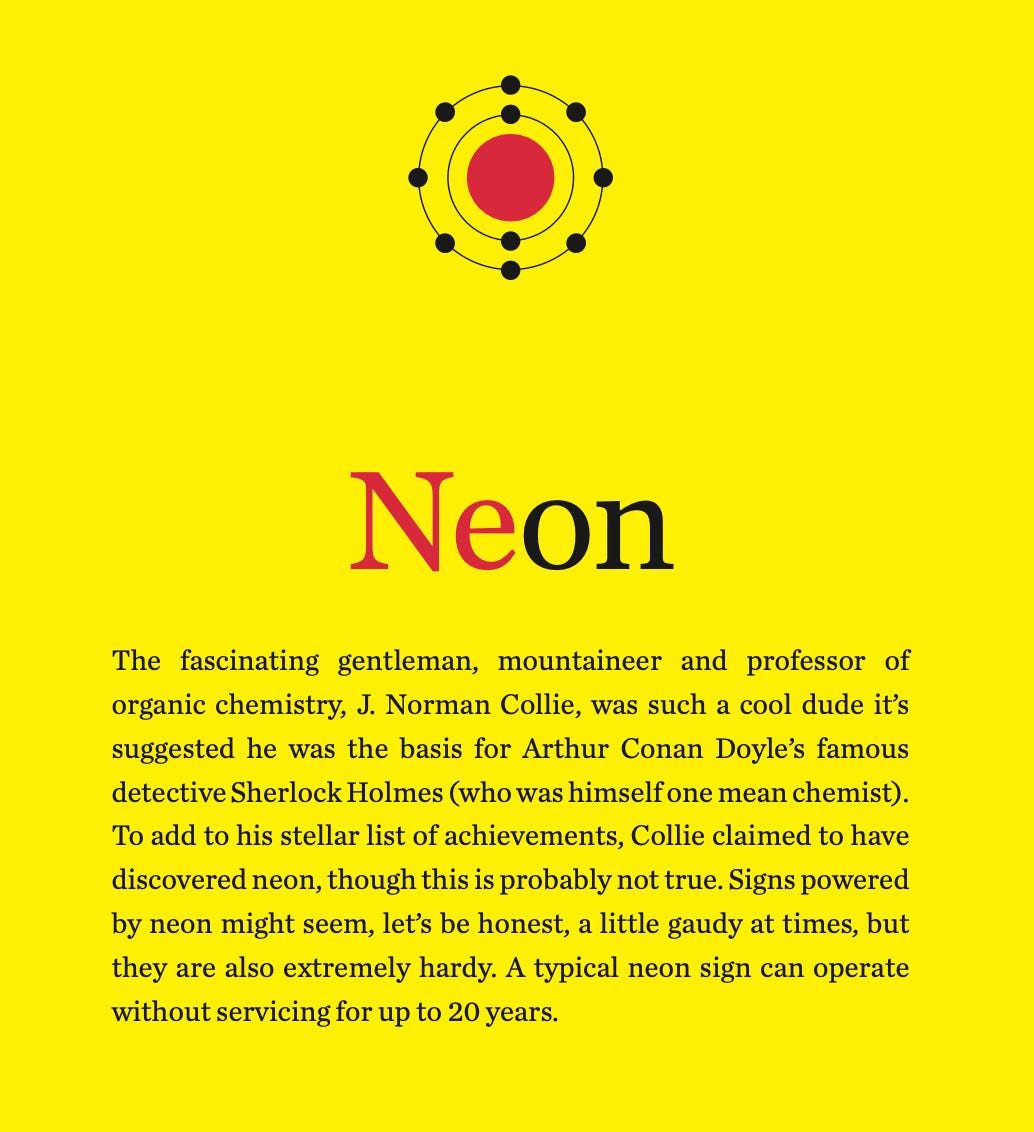
You can tell this by noting that it occupies the furthest spot to the right on the second row of the periodic table. Lithium had one electron in its outer shell. Beryllium had two. Count across and yep, neon has the full complement of 8 electrons. It pats its orbital tummy and says “I’m full thanks, that’ll do me.”
Zap it with electricity, though, and excited neon atoms drop back down and spit out that famous red‑orange glow which made its name on city streets from the 1910s onwards.
Despite the name of every multi‑coloured “neon sign” you’ve ever seen, pure neon only does that one red-orange colour. The various blues, greens and pinks come from other gases like argon, helium and mercury vapour in the same kind of tubes. Often with the glass coated in phosphors that do the actual colour work.
Neon’s marketing team have done awfully well to get all the credit here.
Away from the nightlife, liquid neon is an excellent cryogenic refrigerant, with a narrow liquid range and serious cooling power in some niche applications.
In the universe at large, neon is no bit‑player. It is forged in the hearts of massive stars and is among the more abundant elements in the cosmos.
When I say ‘more abundant’ it only clocks in at roughly 0.13% of everything. But compared to gold at around 0.00000006% it is 2 million times more common. Big dog!
Depending on the size of the star and the stage of its later life, neon can form in a few different ways. One common route is in the extreme heat of a massive star’s late burning stages, when, having burnt through its supply of helium, the nuclei of two atoms* of carbon come together to make a neon nucleus and a special helium-type object called an alpha particle.
Then as the gas cools, 10 electrons come along and bind to each nucleus, (two on the inner shell, 8 on the outside), giving us today's hero, neon.
Later in the death throes, neon atoms play a role in creating magnesium. But that’s another story.
*Chill out mega-PhD-types, yes strictly they aren’t atoms any more. Carbon’s electrons have long since been scorched away and what remains is a soupy plasma of carbon nuclei. This branch of nuclear physics is awesomely wild. And we will meet more soon.
ICYMI last week we got flew through fluorine.
Next week will be so sodium you won’t wanna miss it.
I’m disappointed you didn’t go with:
“Take on ne/
Take ne on”
But even if we’re only writing the words, I still don’t think many of us could hit those high notes 😂😂😂
As a never in the lab chemist who was/is interested in science history, I really hope there are kids reading this stuff.