

Bongs before Bedtime.
Aussie research opens our eyes about having a sly choof before closing them.

Are you one of the one in six Aussies who reaches for a quick hit of the sticky icky icky before drifting off to sleep? Does it help? What if the calmness it gave switched off your ability to dream? Should that matter? Should you care?
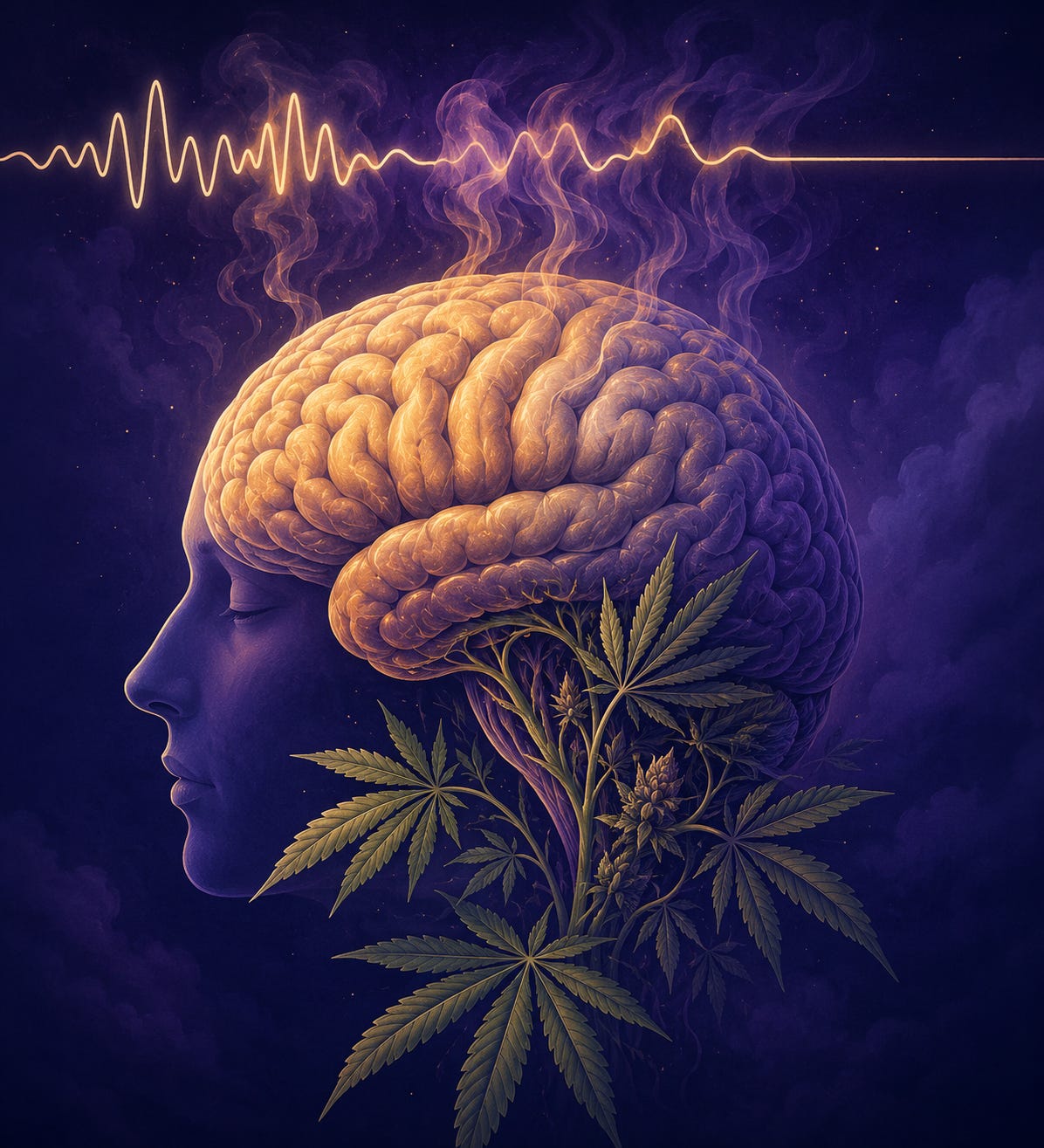
Hashing it out.
A common refrain among many pot users has been they don’t seem to dream all that often. Or if they do, the dreams vanish before breakfast. But if they quit, those dreams come back, big time. Colourful, loud, sometimes scary.
“One more thing I frequently heard from clients who use it regularly or sporadically is that they can’t remember their dreams.” — Eliana Bonaguro, a licensed mental health counsellor specialising in anxiety.
Well one of the world’s leading sleep labs, based right here in Sydney, has strapped on the electrodes and peered into the mull-munching mind, with fascinating results.
NerdNews chomps on a cookie of curiosity and ends up wondering why we sleep at all.
Herb your enthusiasm.
Anastasia Suraev from The University of Sydney’s Woolcock Institute of Medical Research led the research on 20 insomniac adults who were given a single oral dose of an oil containing 10mg of THC and 200mg of CBD. On another, random night they got a placebo.
For those of you not big on the bickies, nodding along as though you know, allow me.
THC is tetrahydrocannabinol – the psychoactive component. This is what gets you high. The difference between “a bit giggly” and “wiped out on the couch”, that’s probably the THC content of that little jazz cigarette.
Cannabidiol, CBD, is THC’s calmer cousin and often the reason some cannabis products are marketed for anxiety and the like.
The research subjects wore caps with 256 electrodes and the results were clear.
On the cannabis night, people slept around 25 minutes less, they took over an hour longer to reach REM sleep – the ‘body paralysed but brain firing as though you’re awake’ stage of sleep, where vivid dreaming happens and we think we process emotions and memory.
Further, when they eventually got there, our sleeping beauties had about 34 minutes less REM. These are significant numbers.
The brain mapping added real detail to our current understanding of the impact of cannabis on sleep. During light sleep it calmed high-frequency activity linked to a racing mind, which is presumably why it feels relaxing. But during deep sleep it flattened the big slow waves that we think are crucial for body restoration.
So it seems that cannabis is more than just a sedative that improves sleep. It reshapes the architecture of the sleep experience, swapping one kind of sleep for another.
Dope dreams.
The hard science on sleep, is, if you’ll forgive the pun, a little bit foggy. We have a lot of solid theories more than hard, indisputable facts. But here is what this research is suggesting.
REM sleep is not just a visit to the dream cinema. It is heavily implicated in consolidating emotional memories and filing away the day’s experiences. One influential idea is that REM acts as a kind of overnight therapy. It is where we soothe the emotional scars from a bad day while keeping the information intact.
“This is when the brain processes the emotional weight of the day, locks in learning and resets the brain circuits that govern mood, judgment and resilience.” — sleep neurologist Joanna Fong-Isariyawongse.

Well the Woolcock research shows THC suppresses REM sleep. The worry is that dulling it night after night might mean that important mental management never quite gets done.
Early days, but well deserving of a longer look.
Reefer removal: REM rebound.
A fascinating insight comes from when regular users stop.
It seems the REM-starved brain, really tries to catch up. ‘REM rebound’ as some in the biz call it, was first documented in the mid 70s and has been replicated many times since.
In plain terms, many cannabis quitters embark on a fortnight of technicolour dreams and broken sleep, typically peaking around days seven to fourteen before settling over a month or so.
It can be unpleasant and for some makes giving up the gunja hard.
Thankfully it is your brain rebalancing rather than breaking.
Getting sober.
It is also important to note, and Suraev and her team certainly do, twenty people, on a fixed eight-hour sleep schedule, receiving a single dose on a single night might give interesting insights. But it is a long way from the real-world experience of cannabis users.
Indeed a 2025 systematic review and meta-analysis in Sleep Medicine Reviews concluded cannabis does not consistently change sleep duration, efficiency or staging.
The dramatic REM suppression comes mostly from small, old trials using big doses of THC. Several modern studies using lower therapeutic doses found mixed or no REM effect at all.
One possible reason is tolerance: the REM-suppressing effect may fade within weeks of regular use, which is exactly when many people are relying on the drug to sleep.
“I’m not anti-cannabis, but I regularly see patients whose sleep has quietly unravelled after months or years of use.” — Joanna Fong-Isariyawongse, writing in The Independent.
The strength of the Sydney work is the detailed picture it paints of where in the brain, and in which stage of sleep, cannabis does its work.
THC you in the morning.
Ah … the morning after.
In fact when tested the next day, while reporting a bit of drowsiness, the subjects were not notably down on reaction time and attention testing.
So “cannabis wrecks your sleep” – probably not. And “cannabis is a harmless sleep aid” - seems a stretch.
As is so often the case, it seems to be a nuanced balance. Yes it can probably help calm some anxiety. But it seems to affect the way you sleep and perhaps shortchange on the deep-wave sleep that does important maintenance work.
Use it occasionally and sleep fine? Knock yourself out (literally).
Depend on it nightly and find yourself foggy or flat? Maybe worth a look.
And if you do give up, sweet (intense, maybe a bit scary) dreams.
Further reading:
Suraev, A., McGregor, I. S., McCartney, D., et al. “Acute Effects of Oral Cannabinoids on Sleep and High-Density EEG in Insomnia: A Pilot Randomised Controlled Trial.” Journal of Sleep Research, 2026. https://doi.org/10.1111/jsr.70124
“Cannabis and sleep architecture: A systematic review and meta-analysis.” Sleep Medicine Reviews, 2025. https://www.sciencedirect.com/science/article/pii/S1087079225001170
Petrova, K. “How a dose of medicinal cannabis alters brain waves during sleep.” PsyPost, 2026. https://www.psypost.org/how-a-dose-of-medicinal-cannabis-alters-brain-waves-during-sleep-2026-03-26/
Feinberg, I., et al. “Effects of high dosage delta-9-tetrahydrocannabinol on sleep patterns in man.” Clinical Pharmacology & Therapeutics, 1975. https://doi.org/10.1002/cpt1975174458